
Public prototype · The hydraulic workbench
Good systems
start with a
clear flow.
Draw hydraulic circuits. Follow the pressure. Understand the motion. Your fluid power workspace, from the first pump to the design record.
Try it without an account. Nothing to install. SI units.
One connected workflow
From a circuit to an explanation.
A hydraulic circuit editor, time-based simulation, sizing calculators and design documentation in one browser workbench.
See what changes
Build a circuit from 14 component types. Play pressure, flow, cylinder position and motor speed together.
02 / Size & compareCheck the numbers
Calculate cylinder force and speed, pump power, pipe losses and accumulator capacity with explicit units.
03 / DocumentKeep the evidence
Sweep a design parameter, compare cases and export the schematic, component schedules and printable report.
Start with a working circuit
Change one value.
Follow the result.
Explore a loaded cylinder, a throttle, a motor, an accumulator or a valve in neutral.
Cylinder lift · directional control
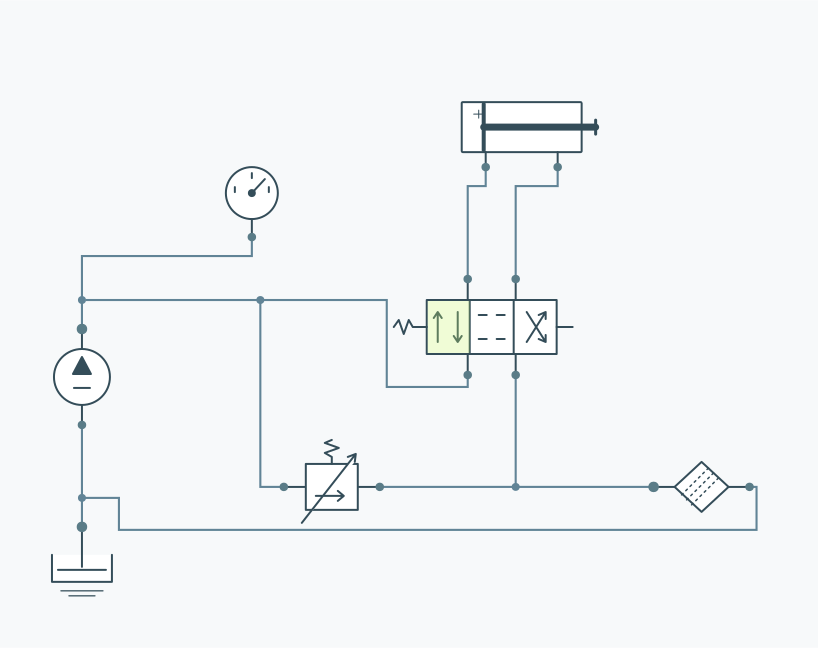
A 63/36 × 400 mm cylinder lifts an 18 kN load. Run a capture to see extension, end-stop arrival and the relief valve taking the pump flow.
FundamentalsThrottle · pressure and flow
A variable restriction returns pump flow to tank. Closing the throttle increases pressure until the relief valve diverts excess flow.
ActuationHydraulic motor · torque and speed
A displacement motor drives a 50 N·m load. Change displacement or pump speed and compare pressure, flow and rotational speed.
Energy storageAccumulator · charging cycle
A 2 L accumulator charges from 50 bar gauge precharge. The gas compresses as oil enters; the relief valve limits the final pressure.
Valve controlTandem center · pump unloading
The tandem center connects P to T in neutral while holding A and B. Set the cylinder load to zero to study unloaded holding and compare pump power with extend.
Learn by building
Your first hydraulic circuit is a few steps away.
Five practical guides explain what to change and what to look for in the result.
Browse the guides →Familiar by design.
Inspired by OhmNest, built for fluid power. PascalNest is a preliminary design and learning tool with generic component models.
Modelled pressure and flow settle at each recorded instant. Actuator motion and accumulator charging evolve over time. Fluid compressibility, hose elasticity and pressure-wave dynamics are outside the current model.